
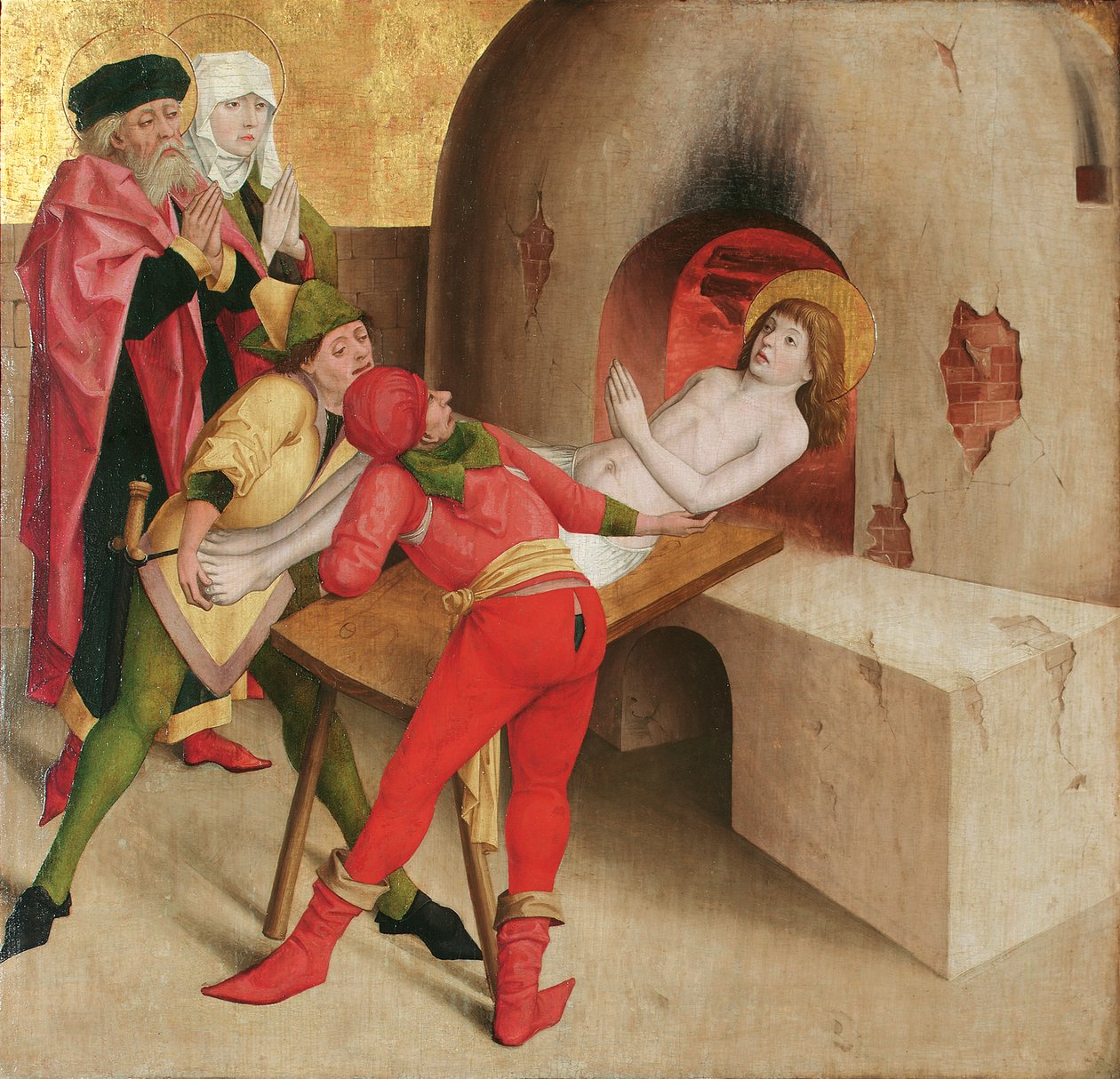
Experienced church- and museum-goers can often identify saints simply by the objects they carry. St. Vitus is no exception. Over the centuries, he acquired a distinctive set of attributes: a lion, a cauldron, and a rooster. But where did this curious soup kit come from?
DOI:
Triple Torture: Martyrdom of St. Vitus
St. Vitus, also known as Veit, Guy, or Guido, lived in southern Italy during the persecutions of Emperor Diocletian. He was born to a pagan nobleman but was secretly raised in the Christian faith by his tutor, Modestus, and his nurse, Crescentia. When Vitus was only seven years old, they left their hometown and traveled the land, performing many miracles along the way.
Vitus became so renowned that he was summoned to heal Diocletian’s son, who was possessed by demons. After successfully casting them out, Vitus was offered great wealth and honors if he would sacrifice to the pagan gods. Of course, he refused. In response, Diocletian ordered the young Christian imprisoned and tortured. Vitus and his companions were first thrown before wild beasts, but even a fierce lion would not harm them. They were then cast into a cauldron filled with boiling oil, yet emerged unharmed. Finally, all three were stretched on the rack and beaten with iron rods. Suddenly, an angel appeared and carried them away, where they eventually died from their wounds.
The cult of the child martyr originated either in Lucania or Sicily. From the fifth century onward, devotion to St. Vitus spread throughout Italy and, by the seventh and eighth centuries, across much of Central Europe, particularly in Saxony and Bohemia. Vitus, Modestus, and Crescentia are commemorated on June 15.


Triumph of the Will and the Body
The Life of St. Vitus is filled with vivid scenes of torture, suffering, and violence. Medieval artists did not hesitate to draw upon the most dramatic moments. They were especially attracted to scenes that were visually striking, emotionally intense, and full of narrative tension. Such repeated depictions of human suffering may seem exploitative or even disrespectful, degrading the complex narrative about spiritual persistence to brutal homicides. Yet, medieval visual hagiography heavily relied on the viewer’s ability to identify with what is being shown.
One way to understand these scenes is through the term «suspended animation». The martyr’s body is caught in a liminal state between life and death. The viewer encounters a body that is about to suffer, about to be wounded, about to die, but has not yet crossed that final threshold. Two more factors facilitate the observation of postponed death. First, suffering is voluntary. The martyr willingly accepts pain. Second, suffering purifies the believer and demonstrates unwavering loyalty to God. The ordeal becomes a kind of test, proving the martyr’s readiness to remain faithful even under extreme pressure. Pain is therefore not the end of the story but a stage on the way to divine joy, grace, and ultimate triumph.
This helps explain a striking feature of medieval martyr imagery: saints almost always appear physically perfect, even in the midst of torture. We rarely see blood, shattered bones, burned flesh, swollen faces, or mutilated limbs. The violence is present, but its bodily consequences are often minimized or omitted altogether. The saint’s body remains strangely untouched, reflecting the belief that spiritual integrity transcends physical suffering.
In a sense, when we look at images of a martyr’s torture, we are invited to adopt God’s perspective. We witness the destruction of the body, yet we also know something that the persecutors do not: the saint has already won. The torturers see a victim. The viewer sees a future saint.

Baptism in Boiling Oil
Apart from the palm branch, a symbol of the suffering endured, which is semi-obligatory for every saint who died as a martyr, St. Vitus is often depicted with a cauldron. It became one of his most distinctive and instantly recognizable attributes during the Middle Ages, coming directly from the hagiography. Artists depicted Vitus either sitting inside the vessel or holding a miniature cauldron as an identifying emblem.
One of the earliest surviving examples of this imagery appears in a mid-twelfth-century fresco from Brauweiler Abbey in present-day North Rhine–Westphalia. The painting shows Vitus and Modestus standing inside a barrel. The scene is placed beside a depiction of the Three Youths in the Fiery Furnace. These two images are linked: both portray faithful believers subjected to fire as a means of punishment or execution, yet preserved through divine intervention. The juxtaposition also creates a bridge between the Old Testament story and the post-Resurrection martyrdom, showing that the dangers faced by the faithful remained the same across the centuries.
The cauldron imagery episode also evokes the symbolism of baptism. In baptism, a person immerses in liquid and emerges spiritually renewed. St. Vitus undergoes a grotesque inversion of this ritual: instead of water, he is plunged into boiling oil and molten substances. One might even see this as a kind of forced baptism. Yet because such a perverse imitation of the sacrament cannot truly work, it fails. The «evil» baptism does not achieve its intended purpose: rather than frying the saints alive, it leaves them completely intact.

Tamed Beast, Tamed Disease
Although animals play only a minor role in the story of St. Vitus, they gradually became central to his visual identity. From the twelfth century onward, the motif of the «tamed beast» was closely associated with the saint. One of the earliest known depictions of this imagery appears in the twelfth-century Passionary of Weissenau. In the left margin of the page, the saint is shown standing full-length between two angels. Vitus appears as a young, beardless man with shoulder-length light brown hair. In his right hand, he holds an oversized palm branch resting against his shoulder, while with his left he tightens the belt of his tunic.
This gesture may carry symbolic meaning. Tightening a belt could represent chastity, moral purity, spiritual discipline, or readiness for action. It may also echo biblical imagery. In the Old Testament, the belt serves as a symbol of righteousness and truth: «Righteousness shall be the belt of his waist, and faithfulness the belt of his loins» (Isaiah 11:5). Likewise, the First Epistle of Peter urges believers to «gird up the loins of your mind» and remain steadfast in faith (1 Peter 1:13).
At Vitus’ feet stands a wild beast with sharp claws, a long-curved tail, and a tongue protruding from its mouth. Wearing high boots, the saint places his left foot firmly upon the animal, symbolically subduing it. The two angels reinforce the scene by pointing downward, directing the viewer’s attention to the conquered beast.
By the middle of the fourteenth century, Vitus had become one of the Fourteen Holy Helpers – a group of popular saints prayed to against different ailments. He was often invoked against rabies, epilepsy, and other neurological disorders. The recurring image of a subdued animal, often a dog or another predatory creature lying peacefully at the saint’s feet, fits well with his reputation as a healer who controls nature.


Cock-A-Doodle-Doo!
So, where did the rooster come from? Since there are no textual references to this bird in the martyrdom, this strange addition urges researchers to look for origins and templates elsewhere.
One explanation is theological. In Christian symbolism, the rooster represents resurrection, vigilance, and the triumph of light over darkness. Its crowing announces the coming of dawn and, by extension, the coming of Christ. The bird’s most famous appearance comes from the Gospels: after Jesus’ arrest, Peter denied knowing him three times, just as Christ had foretold. When he heard the rooster crow, he remembered Jesus’ words and broke down in repentance. This episode appears in all four Gospels, with the Gospel of Mark even noting that the rooster crowed twice (Mark 14:66–72). For this reason, the rooster came to symbolize spiritual awakening, conscience, and faithfulness.
A second explanation, though much more speculative, links the rooster to folk customs. Allegedly, roosters were offered on St. Vitus’s feast day to secure a good harvest. The custom is said to have originated in pre-Christian midsummer rituals involving the sacrifice of poultry. Before the Gregorian calendar reform, the summer solstice fell in mid-June, close to the feast of St. Vitus, and the older seasonal traditions may gradually have become attached to the saint’s cult.
Even if none of the interpretations are correct, by the Late Middle Ages, the rooster had become firmly established as the official attribute of St. Vitus, especially in German-speaking lands.


Anything But Lonely
The growing variety of symbols attached to saints was originally meant to make them easier to recognize. By the end of the Middle Ages, however, this solution had created a new problem. Some saints had accumulated an entire collection of attributes, some of which had rather mysterious origins.
In the case of St. Vitus, it is easy enough to explain the tame lion. The saint’s Life tells how a ferocious beast refused to attack him and instead became gentle. The cauldron is equally straightforward: it refers to the episode in which Vitus survives immersion in a vat of boiling substances without so much as a burn. But the rooster? The rooster seems to have flown from somewhere else. And yet this latecomer proved remarkably successful. The association became so strong that it even inspired local traditions. At the Church of St. Vitus near Neuhofen an der Ybbs in Lower Austria, a priest once built a small chicken coop inside the church.[1] Exactly when the chicken pen was erected remains unclear, but it has since become both a tourist attraction and a cherished local legend.
In the end, the very solution, devised to help people identify saints, created a puzzle of its own. Art historians are still untangling this web of symbols, traditions, and local stories to understand how these images evolved. At least one thing is certain: St. Vitus is anything but lonely. Accompanied by Modestus and Crescentia, surrounded by various creatures with feathers, tails, and claws, he remains one of the most colorful figures in the medieval gallery of saints.

Further Reading:
- Martin, J.-M., and B. Martin-Hisard. “Saint Guy à Rome.” In Chemins de liberté. Mélanges en l’honneur de Guy Lafon, edited by G. Basset and F. Weiser, 185–214. Clamart, 2011.
- Mills, Robert. Suspended Animation. Pain, Pleasure, and Punishment in Medieval Culture. London: Reaktion Books, 2005.
- Eramova, Liudmila. Iconography of Saint Vitus in the Central Middle Ages. Codices Manuscripti et Impressi; Supplementum 26, Okt. 2026. Forthcoming.
References:
[1] Koppensteiner, Thomas. “Ein Hühnerstall auf dem Hauptaltar.” noe.orf.at, December 22, 2016. Accessed May 22, 2026. https://noe.orf.at/v2/tv/stories/2816499/
License declaration for the featured image: Wikimedia Commons CC-BY- 4.0
About the Author
Liudmila Eramova is a PhD candidate in History at the University of Vienna. Her research interests include, but are not limited to, cultural, social, and religious history, Christian iconography, and the cult of saints, particularly those with complex or problematic reputations. Her dissertation examines «The Synaxis of the Three Hierarchs Basil the Great, Gregory the Theologian, and John Chrysostom: a long journey from Byzantium to Russia».
All pictures used are distributed under the Creative Commons 4.0 International License or are in the public domain.
Posted on June 24, 2026 (c) the Author & Public History Studies in Vienna.
This article was written as part of a seminar organised by the Doctoral School of the Faculty of History and Cultural Studies at the University of Vienna. See more articles.
Leave a Reply